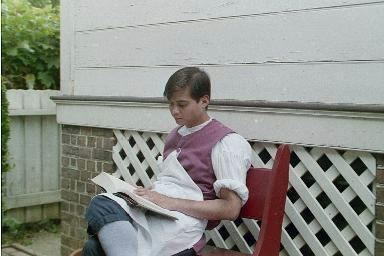
Christiana Essays
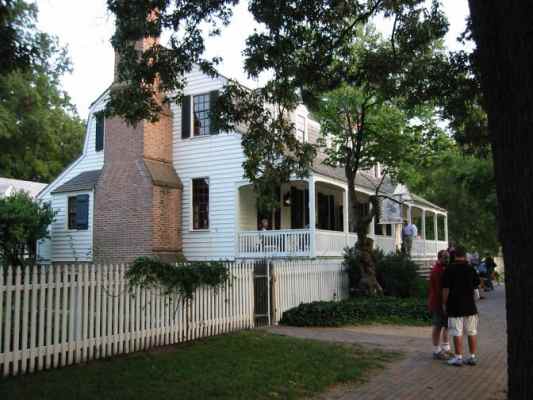
Campbells Tavern Sept 02
Photo courtesy of Alan Carr, Scotland .
Photo courtesy Mark Currier
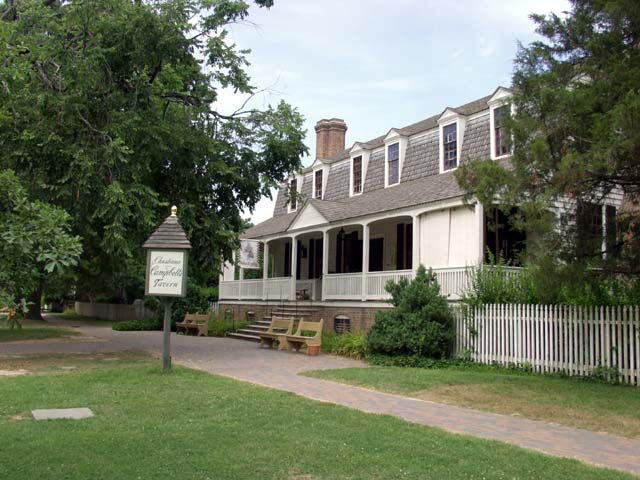
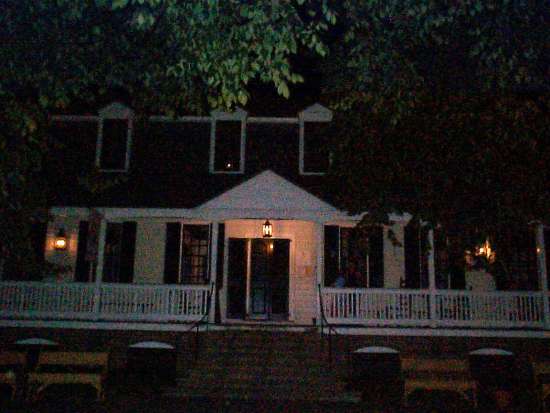
Williamsburg Photo Album courtesy Mark Currier
Christiana Essays
Campbells Tavern Sept 02
Photo courtesy of Alan Carr, Scotland .
Photo courtesy Mark Currier
Williamsburg Photo Album courtesy Mark Currier
Welcome to the website dedicated to subjects related to Christiana Campbells Tavern located in historic Williamsburg, Virginia, USA. This site is a personal site with no official relationship with Colonial Williamsburg Inc. It is edited by Cary Kennedy,waiter at Campbells, and the essays contained here are derived from his keyboard. Cary welcomes contributions, however, and one can add their comments by visiting the message board below or simply email Cary and I will add your essay to the site if you wish. Best regards to all, Cary Kennedy
Sir,
You were our waiter during a very pleasant meal at Christana Campbell's tavern some weeks back, and I told you then that I had written a biography of Mrs. Campbell that had been published in the Dictionary of Virginia Biograpy (Richmond: Library of Virginia, 1998- ), vol. 2, pp. 558-9. You were kind enough to introduce me to Mrs. Campbell, still flourishing after all these years, and you both expressed an interest in seeing this biography. I am therefore attaching a copy, which I would appreciate your passing on to Mrs. Campbell as well. What I have electronically is the nearly final draft; if you want to see it as it actually appeared in print, send me a snail mail address and I'll gladly put a copy for each of you in the mail.
Thanks again for a lovely meal, and all good wishes.
Jeff Looney
Short biography on Christiana Campbell by J.Jefferson Looney
CAMPBELL, Christiana Burdett (ca. 1723–25 March 1792), innkeeper, was the daughter of John Burdett, a Williamsburg innkeeper, and Mary Burdett. Her father died by mid-August 1746, bequeathing her a share of his estate worth at least £300 sterling, including three slaves. Sometime after 21 September 1747 she married Ebenezer Campbell and presumably moved with him to Blandford, now part of Petersburg, where he was an apothecary. They had two daughters, one possibly born after the death of Ebenezer Campbell, whose estate was advertised for sale on 14 August 1752. In an odd act of remembrance, the younger daughter was named Ebenezer.
Christiana Campbell returned to Williamsburg by 7 October 1753, when she had a slave baptized in Bruton Parish Church. She showed her continuing interest in converting and educating her slaves by sending some of them to the Bray School, which taught black children in Williamsburg between 1760 and 1774. Probably starting no later than 1755, when she was purchasing large quantities of wheat and beef, Campbell became one of the borough's most prominent tavern keepers, operating at no fewer than three successive locations. She specialized in offering what she described as "genteel Accommodations, and the very best Entertainment" to a clientele of gentlemen that included George Washington, who between 1761 and 1774 often lodged or dined at her establishments during his visits to Williamsburg. Campbell's signed receipts to Washington attests to her literacy at a time when many women lacked this attainment. Thomas Jefferson also dined regularly at her taverns between 1771 and 1777, but his acquaintance was slight enough that he gave her first name as Catherine when indexing his accounts.
By 18 November 1760 Campbell was renting a lot on the southern side of Duke of Gloucester Street subsequently occupied by James Anderson, the prominent blacksmith and public armorer. Sometime between 25 June 1767 and 16 May 1771, and probably before October 1768, she become proprietor of what contemporary records called the Coffee House, close to the Capitol on the north side of Duke of Gloucester Street.
In an advertisement dated 2 October 1771 Campbell announced that she had moved just east of the Capitol to what is now Waller Street. There she opened her tavern in a building constructed in the mid-1750s and recently vacated by fellow innkeeper Jane Vobe, who soon resumed her own operations at the King's Arms Tavern. Campbell indicated that she would reserve rooms for gentlemen who had lodged with her before. Her sizable one-story tavern, measuring about sixty feet by twenty-four feet with a cellar and a separate kitchen structure, had a public room large enough that the local Masonic lodge regularly held its balls there. Campbell rented the buildings and the two lots on which they stood from the estate of Nathaniel Walthoe until 29 July 1773, when she bought the property at auction for £598 10s. current money. Walthoe himself, formerly her landlord at the Coffee House, had contributed to the purchase with a £200 bequest in appreciation of her integrity and virtue.
Williamsburg suffered an economic decline when Richmond became the new state capital in April 1780. Some tradespeople moved to the new seat of government, but Campbell stayed behind and evidently chose to retire. The only contemporary description of her came from Alexander Macaulay, to whom she denied service on 25 February 1783, stating that she had closed her tavern several years before. The disgruntled traveler portrayed Campbell as "a little old Woman, about four feet high; & equally thick, a little turn up Pug nose, a mouth screw'd up to one side; in short, nothing in any part of her appearance in the least inviting." Macaulay also said that her house had a "cold, poverty struck appearance," but her ownership that year of thirteen slaves and four cattle suggests that she had provided well for herself. Campbell unsuccessfully sought to auction her Williamsburg real estate on 12 March and 8 October 1787, but in the latter sale she had better luck disposing of her household furnishings. She evidently moved thereafter to Fredericksburg, where her younger daughter lived. Christiana Burdett Campbell died on 25 March 1792 and was buried in the Masonic Cemetery at Fredericksburg with a fulsome epitaph attesting to her kindness and generosity. Her Waller Street tavern burned about 1859, but the opening by the Colonial Williamsburg Foundation of the reconstructed Christiana Campbell's Tavern as a working restaurant on 16 April 1956 has made her name recognizable to generations of hungry tourists.
Footnotes
Mary A. Stephenson and Patricia Gibbs, Christiana Campbell's Tavern Historical Report (1990 microfiche ed. of 1952 and 1975 typescripts); some sources give first name as Christian; father's will, dated 30 Aug. 1745 and proved 18 Aug. 1746, in York Co. Wills and Inventories, 20:37–38; estate sales of father and husband advertised in Williamsburg Virginia Gazette, 4 Sept. 1746, 14 Aug. 1752; York Co. Judgments and Orders (1746–1752), 34; John C. Van Horne, ed., Religious Philanthropy and Colonial Slavery: The American Correspondence of the Associates of Dr. Bray, 1717–1777 (1985), 241, 278; York Co. Deed Book, 6:309–311, 8:385–389; Williamsburg Virginia Gazette (Purdie and Dixon), 25 June 1767, 16 May, 3 Oct. 1771 (first quotation), 20 May 1773; two Campbell receipts to Washington at Pierpont Morgan Library, New York, and a third, at CW, reproduced in Donald Jackson and Dorothy Twohig, eds., The Diaries of George Washington (1976–1979), 3:101; Walthoe's will, first probated 31 Oct. 1770, in Principal Probate Registry, London, Eng., 240 Taverner, fols. 2–3; WMQ, 1st ser., 11 (1903): 187–188 (Macaulay quotation); 25 (1917): 152 (Masonic balls); Personal Property Tax Returns, Williamsburg, 1783, RG 48, LVA; Mutual Assurance Society Declarations, no. 485 (1801), LVA; Richmond Virginia Gazette and Weekly Advertiser, 22 Feb., 27 Sept. 1787; Mary Campbell Russell to Ebenezer "Ebe" Campbell Day, 13 Nov. 1787, Papers of Scott and Richards Mercantile Firm, UVA; Williamsburg Virginia Gazette, 13 Apr. 1956; death date and death in seventieth year on grave marker at Masonic Cemetery, Fredericksburg, quoted in Dora C. Jett, Minor Sketches of Major Folk and where they sleep: The Old Masonic Burying Ground, Fredericksburg, Virginia (1928), 24–25. J. JEFFERSON LOONEY

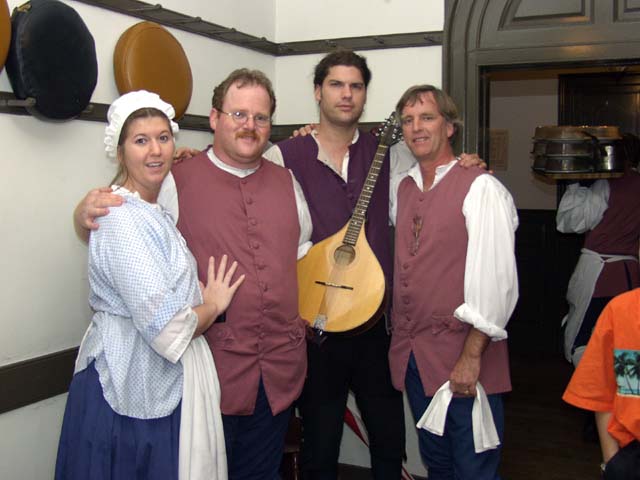
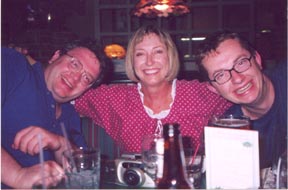
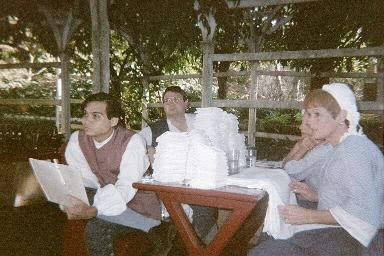
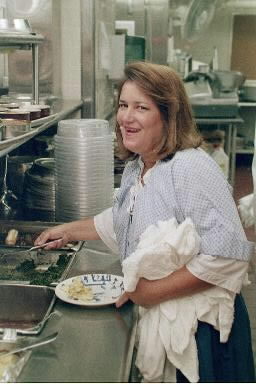
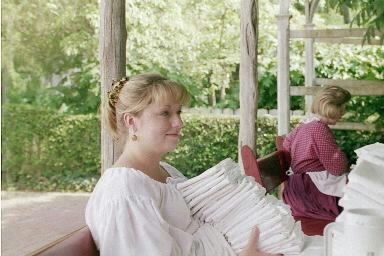
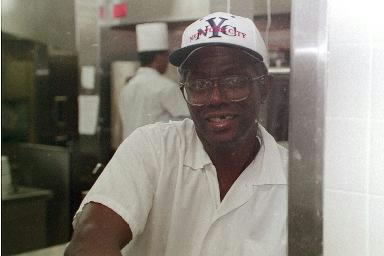
Suzette,Mark,Kris,Cary
 .jpg">
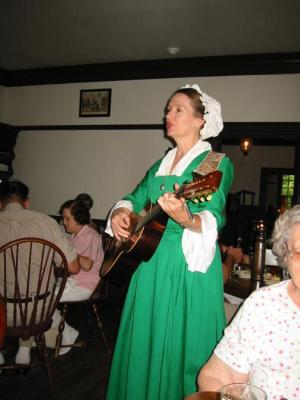
Kathleen the Balladeer
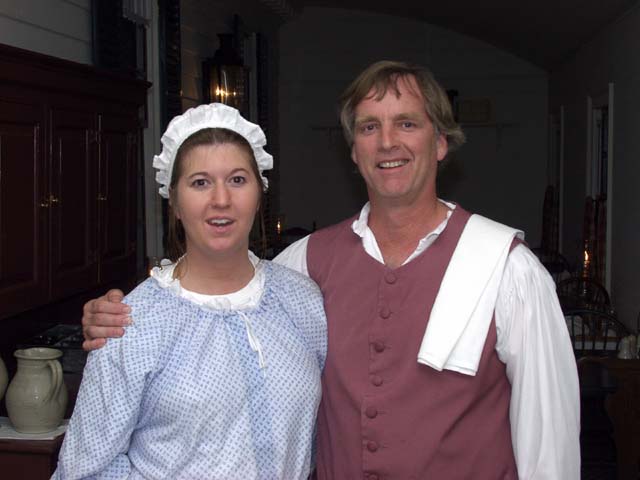
Suzette and Cary
Pictures taken New Years Eve 2002
 Is reservation strategy
costing us?Is management diluting seniority?Why does the working staff have such extradinary longevity?Are we optimizing the
Brunch Stategy?
Is reservation strategy
costing us?Is management diluting seniority?Why does the working staff have such extradinary longevity?Are we optimizing the
Brunch Stategy?
Is "food cost" concerns
affecting longterm guest perceptions?
Have all the factors been considered with our air conditioning woes?
Letter to Clyde Min, Food and Beverage Director for CW.
Click here for visitor commentary
Contact our tavern colleages
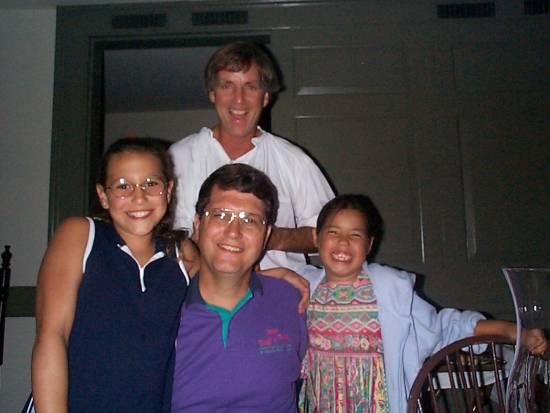
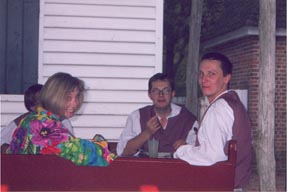
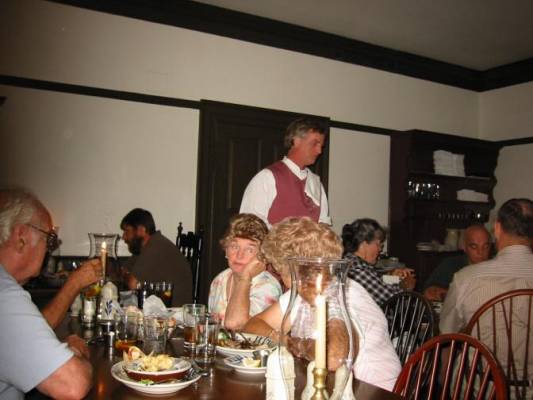
Cary with guests at Campbells
Visit Colonial Williamsburg
"
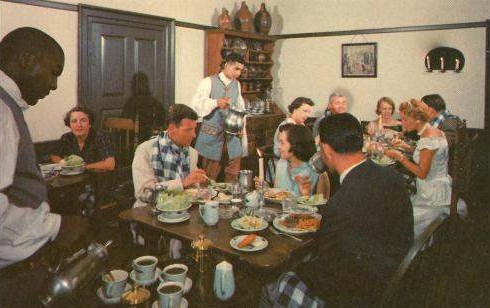
The 1950's ad showing the interior of the coffee house has another waiter. He is pictured in the middle of the photo holding a silver water pitcher. His name is Hugh A. Winfree Jr. He was an artist. He studied at Virginia State University and also at Southern Illinois University's Art Institute. He completed several works of art while working in Colonial Williamsburg, VA.
I am requesting that you add his name to the photo on your website. One of his works of art includes a large watercolor of Mrs. Campbell's Coffee House. I will send you a copy of this art piece to add to your website, upon your request.
H.A.W. Benson"
A Room in the fifties. Dick Owes is the waiter to far left pouring coffee.